
- news
What would happen to the industry if we could break away from "relying on experience and test explosions" and possess a complete methodology that is modelable, reproducible, and directly usable for interpreting results?
Recently, a heavyweight monograph provides the answer. Numerical Simulation of Explosive Welding of Metal Materials, co-authored by Professor Li Huizhong from Central South University, Zeng Zhiheng, Chairman of Hunan Phohom New Material Technology Co., Ltd., and Professor Liang Xiaopeng from Central South University, has been officially published. The book was successfully selected for the National Publication Foundation Project and the "14th Five-Year" Period National Key Publication Special Planning Project, and is included in the "Non-ferrous Metal Theory and Technology Frontier Series."
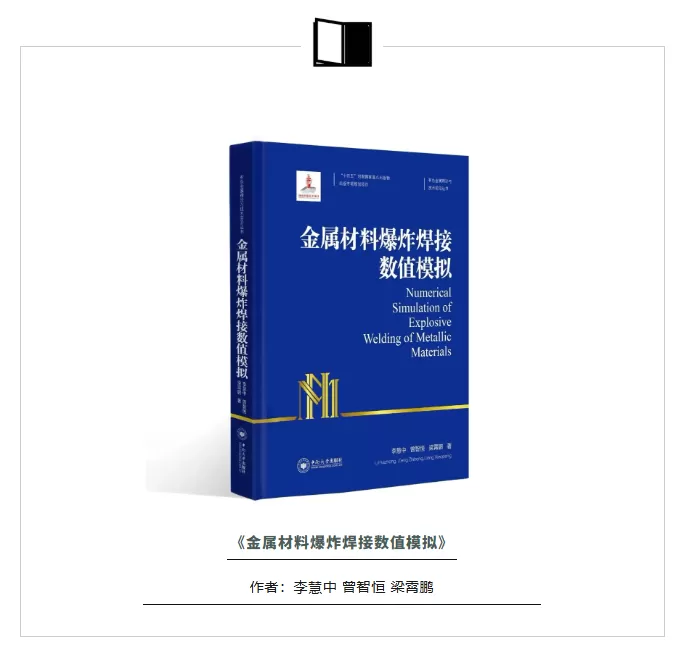
It is not a simple pile of research results, but a complete and systematic theoretical system formed by the deep research accumulation of Central South University combined with Phohom New Material's more than ten years of practical experience in explosive cladding.
Joint Industry-University Research, Landing Industry-University-Research in Process Scenarios
Phohom New Material and Central South University have cooperated for more than ten years. Since its establishment in 2013, Phohom New Material has anchored itself in the high-performance layered metal cladding material track, with metal explosive cladding as its core technology. Over the past decade, they have successively carried out joint research projects and joint talent training. In 2021 and 2025, the Central South University-Phohom New Material Joint Postgraduate Training Base was unveiled in Changsha twice, bringing industry-university-research into the practical operational aspects of production processes.
The research depth of the university collides with the frontline practical experience of the enterprise, making this book both stand at a theoretical height and connect with engineering reality.
Farewell to Blind Test Explosions, Turning Experience into a Simulatable System
However, for a long time, systematic information on explosive welding has been scattered across various papers and engineers' personal experiences. Professional monographs that can completely sort out "from modeling to result interpretation" into a volume are extremely rare.
This book fills this gap, comprehensively covering numerical simulation of explosive welding for six metal combinations: aluminum/lead, aluminum/copper, titanium/copper, nickel/copper, titanium/copper, and aluminum/titanium/steel, while extending to rolling simulation of aluminum/copper and titanium/steel clad plates. The two main lines are fully connected, making it a rare systematic reference book for the industry.
The book clearly lays out a complete and actionable practical path: from explosive selection, determination of the equation of state and constitutive model, to process parameter optimization, Gaussian point parameter analysis of detonation products and flyer plates, and then to the interpretation of simulation results such as wave interface, jet, interface pressure, temperature, and equivalent plastic strain.
More rare is that each type of material combination is accompanied by real preparation experiments and cladding interface characterization data: metallography, SEM, atomic diffusion, microhardness, tensile shear properties, bonding strength simulation calculations and real experiments mutually corroborate each other.
This characteristic of using real process data to improve theoretical models, and then using mature simulation methods to guide on-site production—achieving two-way empowerment of research and process—also led the book to be successfully selected for two national projects.
Turning Internal Process Experience into Publicly Reusable Methods
Externally, this is an industry tool book; for Phohom New Material, this book is also a proof of the enterprise's hard technical strength. Relying on explosive welding technology, Phohom New Material has systematically laid out three major directions: structural materials, high-efficiency conductive materials, and thermal management and extreme heat transfer materials.
Practical experience that was once hidden inside the enterprise has now become a publicly reproducible and verifiable methodology. This also reflects Phohom New Material's vision: we not only bury our heads in making products, but are also willing to explain and pass on the technical methods behind them.
In the future, Phohom New Material will continue to adhere to this path: transforming real-world problems encountered on the industrial frontline into scientific research questions, and then transforming the scientific methods obtained from research into tangible industrial capabilities.